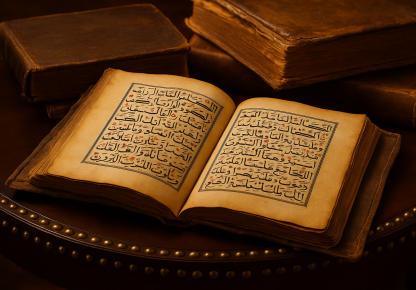
“This is the Book about which there is no doubt” — What Does It Really Mean?

“This is the Book about which there is no doubt” — What Does It Really Mean?

Mar 21, 2026 356 Views

At the very beginning of Surah Al-Baqarah, we are met with a powerful declaration:

"That is the Book about which there is no doubt, a guidance for those conscious of Allah." (2:2)
For many readers, this verse feels both awe-inspiring and challenging. What does it mean to say the Quran is “without doubt”? Are we expected to be doubt-free from the very first page?
The phrase “la rayba fīh” does not deny the reality that readers may have questions or uncertainties. Rather, it affirms the flawless nature of the Quran itself. The Book is perfect in source, in message, and in purpose. If confusion arises, it is not due to a fault in the Book, but due to the natural learning curve of the seeker.
Throughout our learning journey, we all encounter verses we don’t fully understand. We may ask: “Why does this verse emphasize punishment?” or “How does this apply to my life?” Such questions are not signs of weak faith—they are signs of active engagement. We ask because we believe there are answers worth uncovering.
Many classical scholars interpret this verse to mean: there is no falsehood in this Book, no contradictions, no need for revision. Unlike human-made texts, the Quran is a seamless, divine discourse. Its clarity emerges as the reader matures in understanding, not instantly but through reflection, repetition, and prayer.
The verse also includes another key phrase: “a guidance for the muttaqeen”—for those who are mindful of God. This implies that the Quran’s full light opens up to those who approach it with sincerity and reverence. It's not about having perfect knowledge at the start, but about being open to transformation.
So how should we, as learners, live with this verse?
First, accept that having questions is part of learning. The Book welcomes your curiosity.
Second, treat this verse not as a barrier, but as a starting point. It’s not saying “only the doubt-free may enter,” but rather “enter with trust, and you will find certainty.”
Third, return to this verse when you feel lost. Let it remind you that this journey is not about mastering the text overnight, but about walking toward clarity, one verse at a time.
The Quran opens not with demands, but with an invitation. “No doubt” is not a test of your belief—it’s a reassurance that this Book, unlike any other, is a stable foundation in a world full of uncertainty.
When you read “this is the Book about which there is no doubt,” know that it’s speaking to your potential, not your current position. You are not expected to be doubt-free. You are only expected to begin.

Quick answers after reading

  • Does “no doubt” mean no one will ever have questions? No. It points to the truth and reliability of the Quran, even while seekers may still pass through questions on the way to certainty.
  • How do I move from doubt to clarity? Keep reading in context, ask sincere questions, and learn with trusted explanation rather than stopping at first confusion.

More to explore on Munabook

Keep learning with Munabook

Take the next step with guided Quran learning

Keep the momentum going in Munabook with practical study tools, guided app learning, and real teachers when you want deeper support.

  • Daily Quran study
  • AI-supported practice
  • 1-on-1 Quran teachers
Best first step

Start in the app

Build a steady Quran habit with guided learning, daily practice, and AI-supported feedback.

Download the app
Need personal help?

Learn with a Quran teacher

Browse qualified teachers for one-to-one help with recitation, tajweed, and steady progress.

Find a Quran teacher
Quick answers

Questions readers often ask after this article

Short answers to help you keep learning with more clarity and confidence.

What should I do when a Quran verse feels confusing?

Slow down, read the verse in context, compare related verses, and look up trusted tafsir. Confusion is often a sign that you are moving into a deeper layer of understanding, not a reason to stop learning.

Is it wrong to ask difficult questions about the Quran?

No. Sincere questions can be part of serious learning. The important thing is to ask with humility, seek reliable sources, and give yourself time to understand the answer fully.

How can I keep learning without feeling overwhelmed?

Focus on one question at a time, keep a short study routine, and return consistently instead of trying to solve everything in one sitting. Guided learning and teacher support can make that much easier.

Continue exploring this topic Questions & Answers
Previous article Why Are Some Verses Repeated in the Quran? The Meaning Behind Divine Repetition Next article Are There Contradictions in the Quran? How to Approach Seemingly Conflicting Verses
Nabil Mostafa
Author

Mostafa

More from Questions & Answers

How to Understand the Quran Better—Without Overwhelm

How to Understand the Quran Better—Without Overwhelm

Feeling lost in too much Quranic information? Discover calm, practical steps to deepen your Quran understanding without overwhelm. Find your learning pace and

Nabil Mostafa

Mostafa

Mar 21, 2026
Are There Contradictions in the Quran? How to Approach Seemingly Conflicting Verses

Are There Contradictions in the Quran? How to Approach Seemingly Conflicting Verses

Some Quran verses may appear to conflict at first glance. Learn a clearer way to read difficult passages and understand their deeper harmony.

Nabil Mostafa

Mostafa

Mar 21, 2026
Why Are Some Verses Repeated in the Quran? The Meaning Behind Divine Repetition

Why Are Some Verses Repeated in the Quran? The Meaning Behind Divine Repetition

Some verses appear again and again in the Quran—but not by accident. Explore how repetition deepens meaning and draws the reader closer to Allah’s guidance.

Nabil Mostafa

Mostafa

Mar 21, 2026
How to Start Tajweed at Home: A Calm, Practical Routine for Beginners

How to Start Tajweed at Home: A Calm, Practical Routine for Beginners

Discover a gentle, step-by-step guide to starting Tajweed at home. Build a practical Quran routine and make clear recitation approachable—before seeking a tea

Nabil Mostafa

Mostafa

Mar 21, 2026
Finding New Meaning in Familiar Quran Verses

Finding New Meaning in Familiar Quran Verses

Familiar Quran verses can open differently at different moments in life. Learn why repeated recitation often leads to deeper understanding and reflection.

Nabil Mostafa

Mostafa

Mar 21, 2026
The Power of Repeated Reading in Quran Study

The Power of Repeated Reading in Quran Study

Repeated reading helps Quran study move beyond first impressions. Learn how revisiting verses deepens reflection, memory, and personal understanding.

Nabil Mostafa

Mostafa

Mar 21, 2026